I’m a huge fan of historical documentaries that unearth castles and treasures or reveal the rich history of dynasties across the world. It’s just so intriguing how life was back then—and especially how dark and ruthless people were. I know all about the kings and queens who brought progressive reforms and won great wars. But what about those that did some disturbing things and committed atrocious crimes? That’s what I want to learn about.

Giphy
So yet again, I dug deep and found some shocking material. Here are 11 kings and queens who did some really terrifying and questionable things during their reign:
Disclaimer: The following content has mentions of death, violence, sexual assault, and sensitive historical events. Reader discretion is advised.
1. Caligula, known to be Rome’s most tyrannical ruler, was the third emperor of the Roman Empire. His father was Germanicus, who was the nephew and adopted son of Emperor Tiberius. After Caligula’s father’s death and the imprisonment of his mother and siblings, he was sent to live with Tiberius. Upon Tiberius’ death in 37 AD, Caligula was named the sole emperor. He was only 25 years old at the time and was a loved emperor, known for granting bonuses and eliminating unfair taxes. However, a few months after he became emperor, he became seriously ill. Even though he recovered from the illness, it is said that at some point he allegedly went ‘mad’. In 38 AD, he executed Naevius Sutorius Macro, the prefect of the Praetorian Guard who was the reason behind Caligula coming to power. He also executed Tiberius Gemellus, the grandson of Tiberius, who was also heir to the throne.

Heritage Images / Getty Images
He was also the subject of mockery. While Caligula was bald, his body was hairy, which led to him being the butt of jokes by those around him. Anyone who mentioned a goat in his presence (in reference to how hairy he was) because of this joke was rumored to get a death sentence.
Related: I Honestly Believe No One Under The Age Of 20 Will Know What Any Of These Things Are
He displayed great cruelty and erratic behavior. It is said that he liked to remind people of his power by repeating the phrase: “Remember that I have the right to do anything to anybody.” Additionally, he would publicly dress up as various gods and demigods, believing that he was a living god himself. Because he had exhausted the state treasury left by Tiberius, he extorted prominent Roman citizens and confiscated their estates. In 40 AD, he marched his troops to Gaul and plundered the inhabitants. His behavior soon turned the public against him, and conspiracies were starting to form.

Print Collector / Print Collector/Getty Images
In 41 AD, four months after his return from Gaul, Caligula was murdered by Cassius Chaerea, Cornelius Sabinus, and others. His wife, Caesonia, and his daughter were also executed.
2. King Leopold II, the Belgian ruler who ruled from 1865 to 1909, was responsible for the widespread atrocities against his colonial subjects. He believed that the best way to acquire more wealth would be to establish an African colony. He presented himself as someone eager to spread Christianity and Western civilization among the African natives, which was a guise he fronted for many years. He started to develop the Congo River basin and persuaded local chiefs (many of them lacking Western education) by making them sign treaties that were favorable for the king. He even persuaded all major nations of the West that the territory (now modern-day Democratic Republic of the Congo) was his personal property. He called it the Congo Free State, and it was the world’s only private colony, of which he was its “proprietor.”

Universal History Archive / Universal History Archive/Universal Images Group via Getty Images
He made a vast fortune from ivory and made numerous possessions out of it. When rubber became the next significant raw material—with inventions of the inflatable bicycle and automobiles on the rise—Leopold exploited the wild rubber reserves that grew in the Central African rainforests. His private army would enter a village, hold the women hostage, and force the men to gather a monthly quota of wild rubber.
From road building to chopping wood, the natives were forced to work. Many of the women hostages starved, and the men were worked to the point of death. Due to this, thousands of Congolese fled their villages to avoid being forced laborers and found refuge in the forest, where food and shelter were scarce.
One of the most notorious practices under his rule was a direct result of the suppression of those who rebelled against the regime. A Congolese soldier had to prove that they had utilized every single bullet by presenting a severed hand of every rebel they killed. Thus, baskets of severed hands were collected, and due to this, few able-bodied adults were left to hunt, fish, and cultivate crops. This left the Congolese vulnerable to diseases, and the population significantly decreased between 1880 and 1920. The French, German, and Portuguese colonial officials followed this system as well. There was an international outcry due to the king’s system. This pressure forced him to relinquish his ownership of the territory, and it became the Belgian Congo in 1908. This might have ended King Leopold’s reign in Congo; however, the colonial system that took over would continue to exploit the land and the villagers.

Print Collector / Print Collector/Getty Images
3. Queen Ranavalona I of the Kingdom of Imerina (present-day Madagascar) essentially halved the population during her reign in the fight against colonization. She came to the throne in 1828, after the death of her husband, King Radama I. He was a ruler who had embraced European-style reforms and missionary activity, which she quickly reversed when she came to power. At 33 years old, she took firm control of a society facing foreign pressure. European powers were interested in securing opportunities of trade and religious conversion in the monarchy, which would give way for colonization to take over the empire. While the island was officially independent, these foreign influences were growing and portrayed a threat to Queen Ranavalona. She launched a campaign to purge all foreign influences from the island.

Eraza Collection via Alamy
This meant that Christian missionaries were expelled, worship was banned, and converts were persecuted. European technology and customs were strictly restricted, and trade was heavily controlled.
These measures were her form of resistance against the dangers of foreign powers and colonization; however, they also came at a steep internal cost.
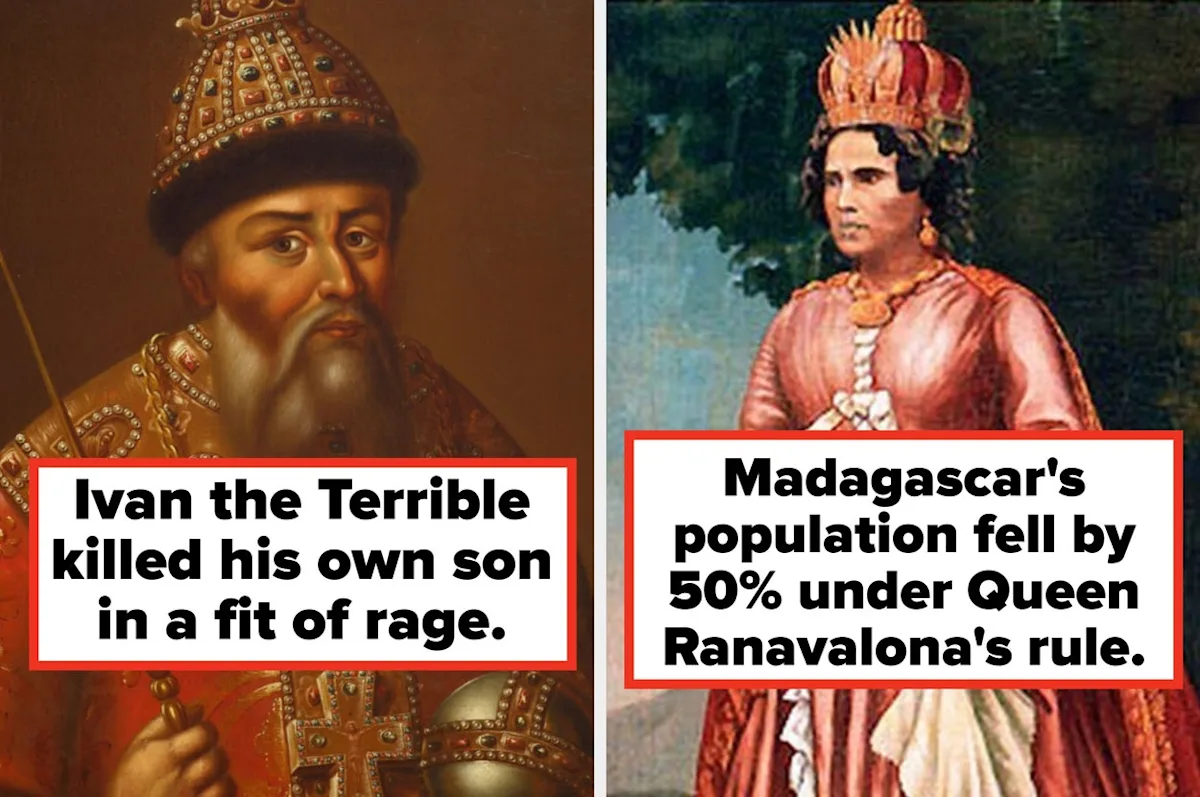
During her rule, trials by ordeal (including the ‘tangena ordeal’) were revived and used heavily. This meant that a person accused of a crime would be forced to drink poison to determine whether they were guilty. If they did not show any reactions to the poison, they were considered innocent. Thousands are believed to have died due to these trials. She also expanded the fanompoana system of state labor, which was forced labor by citizens as a tax payment. The citizens were forced to work on military campaigns and other government projects. It is estimated that Madagascar’s population fell by 50% under her rule. Even those who were accused of disloyalty risked imprisonment, enslavement, or execution. While her work to stop foreign powers was definitely impenetrable for that time, it would not stop the foreign influences in the future.

Chronicle via Alamy
Related: 23 Celebrity Deaths That Were So Dark They Left A Permanent Stain On My Brain
4. King Henry VIII of England had a turbulent rule over England. He is notably known for his six wives and for having killed an estimated 57,000 people during his 36-year rule over England. One of the killings that we remember from history is that of Anne Boleyn, whose daughter would become the longest-reigning Tudor monarch, Queen Elizabeth I. Anne Boleyn was his second and most infamous wife, for whom he changed England’s religion and separated from the Church of Rome to marry. When Anne Boleyn failed to have a son, she found herself in a conspiracy accusing her of infidelity with five men. She was sentenced to death in the Tower of London.

Universal History Archive / Contributor / Print Collector / Contributor
His third wife, Jane Seymour, produced a son, which Henry VIII much desired; however, she tragically died during childbirth.
Queen Catherine Howard was 17 when she married the 49-year-old king, days after he had obtained an annulment from Anne of Cleves. When the king found out that she had had sexual relations at 15 with an older man, named Francis Dereham, it was seen as treason. Under the ‘bill of attainder,’ Catherine was sentenced to death with no trial. His last wife, Catherine Parr, outlived Henry.
Aside from his failed marriages, his messiest separation was that with the Catholic Church. After failing to get his first marriage annulled, the king had his adviser, Thomas Cromwell, get Parliament to pass a law making Henry the head of the Church of England. And in 1532, the law was passed, which exempted England from the pope’s authority. This increased Henry VIII’s power exponentially. Those who opposed this were immediately executed. Additionally, he had members of the Pole and Courtenay families executed for supposedly conspiring against him.

Print Collector / Print Collector/Getty Images
Historian John Stow claimed that Henry VIII had around 70,000 people executed (although this is believed to be an exaggerated number), but it was near the thousands, including the execution of 67-year-old Margaret Pole, who was once his daughter governess. His reign is one of the bloodiest and messiest in history.
5. Ivan IV, also known as Ivan the Terrible, was the first czar of Russia. His reign was marked with brutality and paranoia, including executions and other regressive forces to kill. He ascended the throne at a young age in 1530, after his mother died. He brought about a series of reforms, including increasing the power of the state over the Russian Orthodox Church and bringing the domains of Muscovy (the Latin name for Moscow) under control. He also started military campaigns where he conquered important Mongol territory; however, the war stretched for decades, leading Mongol raiders to sack and burn Moscow until Ivan surrendered. What history remembers of his reign, however, is his paranoid behavior.

Heritage Images / Getty Images
He executed thousands of suspected traitors, particularly boyars (the highest rank of feudal nobility). He organized the Oprichniki—a personal praetorian guard that would enforce a rule of terror over Russia while he eliminated his opposition. The oprichnina—Ivan’s reign of terror using the oprichniki—lasted seven years. It is said that Ivan later sent memorial lists of more than 3,000 of his victims (most of whom were executed by the oprichniki) to various monasteries so that they are prayed for. It is said that he might have been suffering from mental illness since his actions had become increasingly violent. He killed his own son in a fit of rage and massacred thousands of people in the city of Novgorod in order to suppress a conspiracy that might not have existed in reality but rather in his mind. This stained Ivan’s reputation as a king. He died in 1584.

Heritage Images / Getty Images UniversalImagesGroup / Contributor
Related: 18 Of The “Biggest Historical Lies” People Somehow Still Believe Despite Evidence To The Contrary
6. King John of England was forced to sign the Magna Carta due to his abuse of power. He was known to break the taboo of the honorable captivity—which meant that when an aristocrat was taken as a prisoner from a battle, they were to be treated honorably until the ransom was met. John did not follow this tradition, and he arranged for the ‘disappearance’ of his nephew and rival, Arthur of Brittany. It is said that Arthur was killed by accident, although others pointed fingers at John for murdering his nephew. But the most notorious crime that King John committed was starving 22 knights to death. The knights who were fighting for Arthur were starved to death in Corfe Castle after Arthur refused to surrender. It was said to be the most cruel punishment given to the knights.

Print Collector / Print Collector/Getty Images
Perhaps the worst use of this starvation technique was on King John’s former friend, William De Briouze’s family—his wife Matilda and his son, William. In 1210, he imprisoned the mother and son in his castle and starved them to death.
Moreover, he attacked the church as well. Furious with the pope over the appointment of a new archbishop of Canterbury, he drove the monks of Canterbury into exile and seized the lands of the English clergy. This led to the king himself being excommunicated in 1208. His treatment of the church only charged the people’s fury against him. But the breaking point was when he lost Normandy, Anjou, Maine, and parts of Poitou in 1206; his reputation took a huge hit, and he was determined to win it back. So he became increasingly ruthless with his financial administration, raising the taxes and exploiting his feudal rights. This abuse increased discontent within his barony.

Print Collector / Getty Images
Negotiations between John and his barons failed, and a civil war broke out in 1215. John was again called to negotiate with the rebels, and finally, in June 1215, he accepted the baronial terms. After further revisions were made to the document, the king signed the famous Magna Carta, which ensured feudal rights and restated English law.
His reputation and reign were further degraded. He was known as a suspicious, vengeful, and treacherous king.
7. Nero was the fifth Roman emperor and stepson of the emperor Claudius. He was infamous for his debauchery, the burning of Rome, and the persecution of Christians. He did not direct the government himself but rather used his autocratic powers to pursue his grandiose plans. He would spend his evenings on the streets, often rioting with others, and this act was a big scandal to the people at the time. He executed his mother because of her overbearing nature and fury at seeing her son get out of control. Additionally, he had his wife, Octavia, murdered after having fallen in love with another woman: the empress Poppaea.

Heritage Images / Getty Images
But the reason why he is considered to be one of the most cruel emperors of the Roman Empire is the Great Fire of 64. Nero was not responsible for the fire itself, but after the destruction caused by the fire, he began building a massive palace—the Golden House—which was never fully finished. This led to the Roman citizens believing that the emperor started the fire to build a new palace. In order to shift responsibility for the fire, Nero blamed the Christians, who were thought to have engaged in many wicked practices at the time. It was due to this that Nero had accidentally initiated the persecution of the Christians, and by doing so, earned himself the reputation of the Antichrist.

Hulton Archive / Getty Images
8. Timur, a Turkic conqueror who started off as a bandit and then rose to become a mighty conqueror of Central Asia. He was the ruler of the Chagatai Khanate, with the capital at Samarkand. He was known to be ruthless, cunning, vengeful, and cruel. He claimed to be the restorer of the Mongol Empire, although his campaigns were more like large-scale looting. In the 1380s and 90s, he invaded Russia and Persia and ravaged Azerbaijan, Armenia, Georgia, Iraq, and Mesopotamia. He was infamous for destroying cities and massacring their populations. He would then build large triumphant towers made of his victims’ skulls and take the survivors as slaves.

Universal History Archive / Universal History Archive/Universal Images Group via Getty Images
His last major campaign was aimed against the Ottoman Sultan, Bayazid I, and the Mameluke Sultan of Egypt. He headed towards the ancient town of Damascus. The garrison of the city was already weak. What remained were some forty men to defend Damascus; however, they surrendered after a month. Following the surrender, Timur extorted a huge ransom and then let his men ravage the town. They pillaged and looted the inhabitants; the men were let loose to rape, torture, burn, crush, and enslave the residents. Children were left to starve while their mothers were taken away. His cruel nature was later turned into a biography by twelve-year-old Ahman ibn Arabshah, one of the residents he had enslaved. Timur would fall ill and die in 1405.

Pictures From History / Pictures From History/Universal Images Group via Getty Images
Related: Only True Disney Fans Can Name These Movies With Just 3 Hints
9. Queen Mary I, or infamously known as ‘Bloody Mary,’ was the daughter of Henry VIII and his first wife, Catherine of Aragon. Mary was a Roman Catholic, and she became queen in 1553. To secure a Catholic succession, she married Catholic Philip of Spain, the heir to the Spanish throne. This was met with disapproval from the public, especially a rebel group led by Protestant Thomas Wyatt the Younger, but Mary refused to hide away and asserted her authority. She then had Wyatt executed after the rebels dispersed. This was just the beginning of her reign, and her determination to keep Catholicism as the realm’s faith, would give her the nickname, ‘Bloody Mary.’

Universal History Archive / Universal Images Group via Getty Images
The specific reason behind the title was her revival of the heresy laws. These stated that a person who did not follow the faith of the realm would be burned to death. During the years of Mary’s reign, around 300 men, women, and children were burned at the stake across England for not practicing Catholicism. One of the victims included Thomas Cranmer, who had been the Archbishop of Canterbury during Henry VIII’s reign.

Print Collector / Print Collector/Getty Images
10. Vlad III “the Impaler” of Wallachia was a voivode (military governor or prince) who was infamous for his cruel methods of punishing his enemies in the 15th century. In order to regain his father’s seat, he embarked on a lifelong series of campaigns. It was only after an eight-year struggle that Vlad claimed the seat. During his period of rule, the atrocities he committed became his reputation. He used to impale his enemies on stakes in the ground and leave them to die—earning him the name Vlad the Impaler. After retreating from a battle in 1462, he left the field filled with thousands of impaled victims as a deterrent to the incoming Ottoman forces.

Print Collector / Getty Images
11. Pope Clement VII’s papacy was marked with significant political challenges, with one such political maneuver leading to the Sack of Rome in 1527, which resulted in widespread destruction and loss of life. Giulio de’ Medici became Pope Clement VII in 1523. He began his jurisdiction as the pope, stuck in between the political ambitions of King Charles V of Spain (also the emperor of the Holy Roman Empire), and King Francis I of France. In fear that he might end up in total control of Charles, since the Spanish already ruled the entire southern part of Italy, Pope Clement supported Francis in 1524. Clement thought that there was greater independence in France as the pope. This infuriated King Charles, and his troops fought with the French army; however, the Spanish army emerged victorious and took King Francis I as prisoner. Scared for the future of the Roman Catholic Church, Clement sided with Charles, and this placed all of Italy under Spanish protection.

PHAS / Universal Images Group via Getty Images
Following this, Sforza of Milan conspired to overthrow the Spanish rule, along with Pope Clement VII’s support, by bribing the marquis of Pescara—but this failed when Pescara exposed it to Charles. Meanwhile, Francis I was released from captivity after renouncing claims to Burgundy and Italy, then joined Clement in forming the League of Cognac (1526) against Spain—an alliance too weak to succeed since Francis did not have the money to support the military.
In 1527, forces led by Pompeo Colonna, a pro-Spanish cardinal, along with a force of German mercenaries, attacked Rome. Panicked, Clement attempted to secure a treaty with the Spanish ambassador to the Vatican, but it was too late. The German mercenaries had not been paid for their services, and so they advanced to Rome. Thus, the sack of Rome had begun. Captives were held for ransom, and those who could not pay were executed. The mercenaries, who were primarily Protestants, ruined the Catholic churches and religious objects. Nuns were raped, tortured, and killed. The Tiber River was filled with the dead bodies of victims. The inhabitants of Rome blamed the destruction of the city on Pope Clement VII’s broken promises. He had no choice but to sign another treaty that gave control of the pope to the Spanish king’s dominion, decreasing the catholic church’s authority.

Universal History Archive / Universal History Archive/Universal Images Group via Getty Images
Yikes! I knew dark and grisly events took place during the reign of these kings and queens, but I underestimated just how cruel and horrifying they were. I’m truly glad I no longer live in an era where the punishment of being ‘hanged, drawn, and quartered’ exists. Which other king or queen do you know of, that did some really questionable and disturbing things during their rule? Let us know in the comments.
Also in Rewind: Answer These ’80s, ’90s, And 2000s Trivia Questions And We’ll Guess Your Exact (And I Mean EXACT) Age
Also in Rewind: People Are Sharing The Weirdest, Eeriest, Most Fascinating Historical Events That 100% Read Like A Time Traveler Altered History
Also in Rewind: 24 Absolutely Bizarre Historical Events I Can Hardly Believe Actually Took Place
Read it on BuzzFeed.com