Jim O’Keefe was heading to the grocery store Sunday morning when he noticed the lights outside his apartment changed.
The sky turned gray, which the weather forecast had not predicted.
“I walked outside and smelled it. I knew it wasn’t a cloud,” said O’Keefe, a Palm Springs resident who lives in his winter home in Puerto Vallarta. “That’s smoke.”

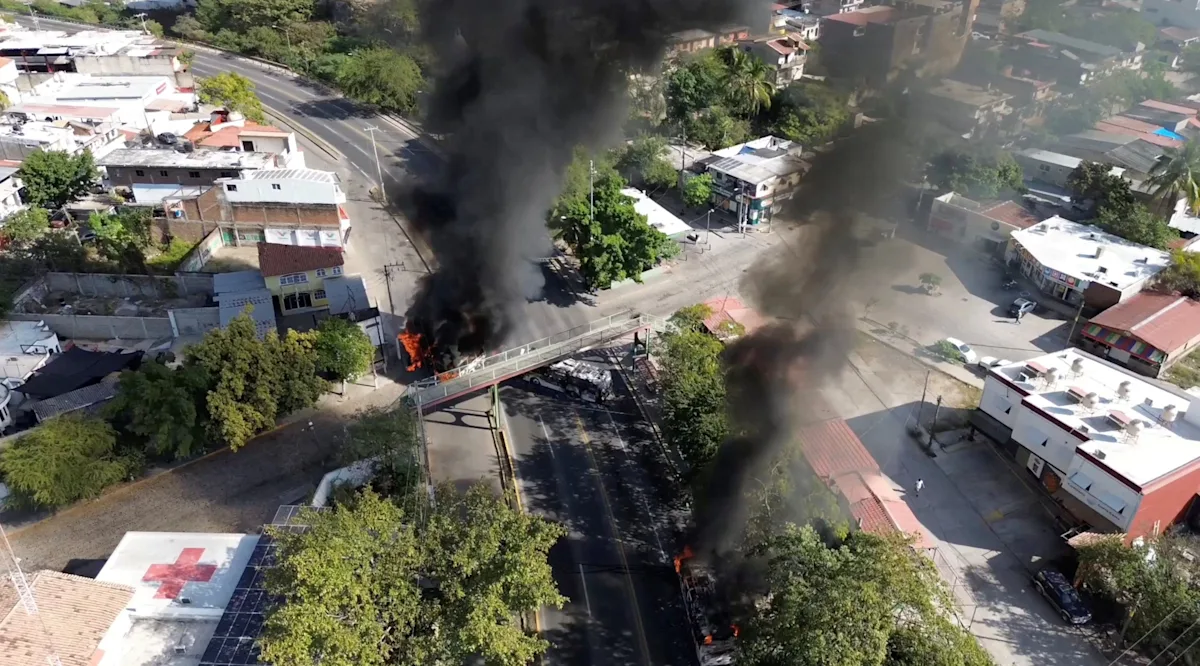
Thick smoke billows from a neighboring building across from the courtyard of Jim O’Keefe’s apartment in Puerto Vallarta, Mexico. The Palm Springs resident, who spent the winter in the Mexican resort town, took the photo on Sunday, February 22, as unrest spread across parts of Mexico following the death of a senior Mexican drug cartel leader.
The death of a top drug cartel leader sparked widespread unrest in Mexico starting on Sunday, February 22, filling the seaside resort town with smoke, prompting the United States to urge Americans to shelter in place and disrupting travel.
The security alert extended to the Mexican state of Baja California, which borders California.
Nemesio Rubén Oseguera Cervantes, also known as “El Mencho,” was killed during a military operation announced on Sunday, February 22. He leads the Jalisco New Generation cartel, which the United States designated as a foreign terrorist organization in 2025. The U.S. Drug Enforcement Administration describes the cartel as one of the most “powerful” and “influential” criminal organizations in Mexico.
His death was followed by road jams and violence in several areas of Mexico, including Puerto Vallarta, a popular beach resort in Jalisco state frequented by U.S. tourists, including many from the Coachella Valley. Like Palm Springs, Puerto Vallarta is considered one of the top vacation and retirement destinations for LGBTQ people.
O’Keefe, who has wintered in the resort town for 25 years, walked upstairs to the roof of his building in Santa Maria. Santa Maria is a primarily middle- and working-class neighborhood along Highway 200, the city’s main thoroughfare, before the road reaches the Hotel District.
From there, he could see smoke rising from multiple points on the skyline.
“There were spot fires everywhere,” O’Keefe said. “There are new fires happening every 15 minutes, 30 minutes.”
By late morning, traffic was at a standstill, with roadblocks cutting off traffic across the city. Authorities urged residents and visitors to shelter in place. The U.S. State Department issued a security alert urging Americans in several Mexican states to shelter in place until further notice.
O’Keefe turned on the television to get an update. Although his Spanish is “a little wonky,” he said the message is unmistakable and hasn’t changed.
In a message to a friend on Monday morning, February 23, he described reports of buses being hijacked and roadblocks being set up along the highway.
“That section of Highway 200 was the first target hit at dawn yesterday at the PEMEX (gas station) in Amapas,” O’Keefe wrote. “They hijacked three buses, got everyone off, set up empty buses on the road as barricades, and then firebombed them.”

A bus was burned at the intersection of Francisco Villa Avenue and Highway 200 during unrest following the death of a top drug cartel leader on Sunday, February 22, 2026, in Puerto Vallarta, Mexico.
When the convenience store at a Pemex gas station was targeted, he recalled, it was just a gas station away from an apartment building.
“Almost at that moment I heard a loud bang and saw smoke rising,” he wrote.
In his fourth-floor apartment, he heard “explosive flames” that sounded like “an exploding tire or a fuel tank.”

Smoke rises from a building near Jim O’Keefe’s apartment in Puerto Vallarta, Mexico, on Sunday, February 22, 2026, as unrest spread to parts of the country following the death of a top drug cartel leader.
O’Keefe said initial concerns that civilians would be involved in the violence didn’t match what he observed. Residents themselves did not appear to be targeted, he said. In his view, the purpose of fires and roadblocks is to send a message, not to cause widespread harm.
“My theory is, these guys did their thing for a day, and then they melted right away,” he said. “The point has been made.”
Still, the chaos spilled over into daily life. The highway was closed. Airport operations are suspended. Gas stations are closed. Even the OXXO convenience stores found in almost every neighborhood are closed.
By Sunday evening, the fire was largely extinguished, and familiar sounds heralded changes in the neighborhood.
“I started hearing dogs barking,” O’Keefe said. “People were walking their dogs on the street and it made me realize I could probably go outside for a while.”
He ventured out for about an hour. Evenings usually draw residents and visitors to the streets for a leisurely stroll. This time, people are traveling with a purpose—to go home and run errands.
O’Keefe said some roadblocks had been cleared at a major intersection along the highway. Others stayed. Elsewhere, he saw the charred remains of a convenience store.
“They’ve removed several bus wrecks,” O’Keefe said. “There’s just a burned taxi and a bus left.”
Palm Springs Police Chief Andy Mills advised locals in a Facebook post on Sunday to avoid traveling to Jalisco “until things settle down.”
Among those who responded was Palm Springs resident Kirsten Peterson-Gardea, who said she was already in Puerto Vallarta.
“Yes we are here and this is crazy!!” she wrote. “We are safe and currently on lockdown. Many vehicles and buildings have been set on fire. It saddens me to see something like this happening in such a beautiful place with such beautiful people!”
Peterson-Gadia told The Desert Sun on Monday that has changed.
“Yesterday was pretty crazy but today has been very quiet and calm,” she wrote. “All the smoke has cleared and the National Guard and Marines are in the area.”
O’Keefe also took a noticeable turn Monday morning. Three blocks from his apartment to the highway, the steady noise of traffic disappeared.
“It was very quiet,” he said. “Exceptionally quiet.”
The sky looked different, too—not entirely clear, but no longer shrouded in smog compared to the gray shadow that had hung over the city the day before.
He plans to walk to the nearby Soriana supermarket to restock groceries. If things go well, he said, he’ll pack a small picnic and head to the beach. He later said crews were already repairing fiber optic lines and damaged sidewalks at an intersection he visited the night before.
“I come every year because there’s always something fun to do,” O’Keefe said. “Some years are more fun than others and this will be a memorable one.”
Are the borders closed today? What we know about San Isidro, Calexico, and more
Southern California has multiple crossings, including the heavily trafficked San Ysidro crossing to Otay Mesa to the east.
In a statement to the USA TODAY Network on Monday, February 23, a U.S. Customs and Border Protection spokesperson said that all ports of entry along the southwest border are “open and fully operational” and “there are no plans to close.” These include the San Ysidro and Otay Mesa crossings.
“U.S. Customs and Border Protection is aware of and monitors incidents of violence in Mexico,” a U.S. Customs and Border Protection spokesman said.
U.S. Customs and Border Protection “defers to the Government of Mexico” regarding travel information to Mexico.
On the morning of February 23, the California Highway Patrol and Caltrans did not immediately respond to questions about any known affected travel, including border crossing closures.
Calexico West and Calexico East; San Ysidro, Otay Mesa; Tecate; Lanes at the Andrade and Andrade crossings are open as of Monday morning, February 23, based on CBP wait times.
Motorists in Mexico are encouraged to follow the Mexican Highway Agency (CAPUFE) on X for the latest information on affected roads.
Which areas of Mexico are affected? US Security Alert Checklist
The U.S. Embassy identified the following locations in Mexico in its security alert urging Americans to shelter in place: Jalisco; Baja California; Quintana Roo; Nayarit; Sinaloa; and areas in Colima, Guanajuato, Guerrero, Mexico, Michoacán, Nuevo Leon, Oaxaca, Puebla, Queretaro, San Luis Potosi, Tamaulipas, Veracruz, and Zacatecas.
Where is Jalisco, Mexico?
Jalisco is a state in Mexico located northwest of Mexico City and includes cities along Mexico’s west coast. Officials said a shootout broke out and Oseguera was seriously injured.
Flight to Mexico canceled?
In its latest update, the U.S. Embassy said most domestic and international flights in Guadalajara and Puerto Vallarta have been cancelled. Dozens of flights to the two cities’ airports have been canceled as of Monday, February 23, according to FlightAware.
Can I go to Mexico for Spring Break 2026? Check Mexico travel warnings
The riots occurred weeks before California college and K-12 students enjoyed spring break. There are still a few months until Guadalajara hosts a World Cup match.
It’s unclear how tensions in Mexico will affect safe travel in the coming days and weeks. However, travelers can review travel warnings issued by the State Department across Mexico to better understand the level of caution they should take before arriving. Ahead of spring break in 2025, six states in Mexico are under a Level 4 travel advisory, the highest level that can be issued and where officials advise citizens not to travel. Meanwhile, the state of Jalisco, home to Puerto Vallarta, has issued a Level 3 travel warning due to crime and kidnappings.
USA TODAY’s Paris Barraza contributed to this report.
Jennifer Cortez covers education in the Coachella Valley. Contact her at jennifer.cortez@desertsun.com.
This article originally appeared in Palm Springs Desert Sun: Palm Springs man describes scene in Puerto Vallarta