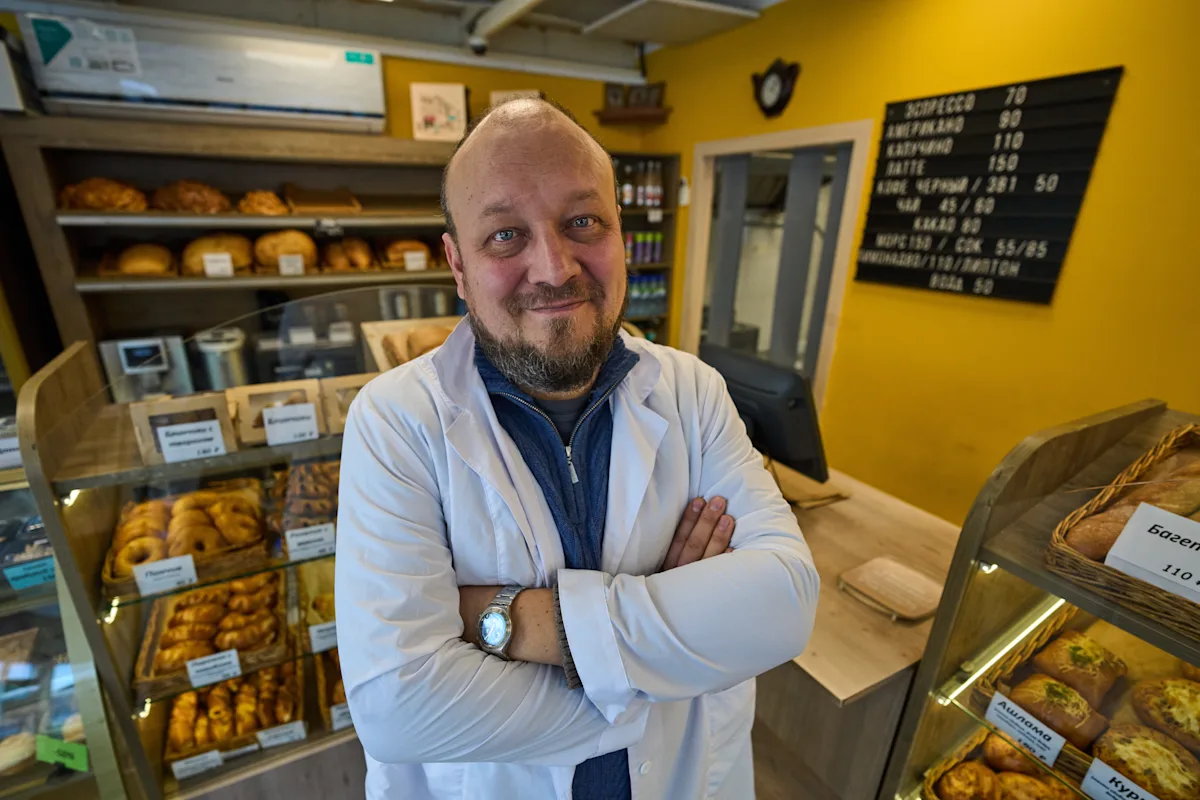
Denis Maksimov’s bakery in a Moscow suburb became an overnight sensation after appearing on President Vladimir Putin’s annual call-in show last December.
Standing in front of the bakery (named “Mashenka” after his eldest daughter), he implored Putin via video to look into new tax reforms that would significantly increase the burden on small businesses like his.
“We know very well that this will not be easy for the country. We know that tax increases are necessary,” Maximov said. “Frankly, we’re not optimistic about the future. A lot of (businesses) are going to go out of business.”
As Putin marks the fourth anniversary of his full-scale invasion of Ukraine, growing pressures on the Russian economy are beginning to emerge. Oil revenues are declining, budget deficits are rising and military spending, which has driven strong growth, has leveled off.
The Kremlin is now looking to consumers and small businesses for funding. The value-added tax was increased by 2%, and the income threshold for enterprises to pay value-added tax was significantly reduced.
Ordinary Russians seem to be feeling the pain, too. Business owners interviewed by The Associated Press said demand for their goods and services has been falling and costs have suddenly increased as suppliers adapted to tax changes, with the tax burden now increasing dozens of times. Some said they scaled back to continue operations, while others closed.
A recent video on social media showed the economic impact: commercial spaces on Nevsky Prospekt, St. Petersburg’s main street, are vacant and stores are closing one after another.
“I have never felt so scared, so unprotected, so anxious as I have this year,” said Darya Demchenko, who owns a chain of beauty salons in Russia’s second city.
failed defense
Maximov’s pleas to Putin failed to reverse tax reforms that would have lowered the threshold for companies to pay value-added tax from 60 million rubles ($783,000) on annual sales revenue to 20 million rubles ($261,000) this year and to 10 million rubles ($130,500) by 2028.
Income thresholds are similarly lowered for those using the “royalty tax system,” in which small businesses pay a fixed annual fee – often just tens of thousands of rubles – rather than a percentage of their revenue or profits. This year, businesses with revenues of more than 20 million rubles will need to pay at least 6% income tax and at least 5% value-added tax.
During their televised exchange, Maximov said he had been using the patent system for eight years, and Putin responded that tax reforms were needed to address “uncontrolled” illegal imports, but promised to look into what measures could be taken.
Maximov’s presence attracted attention and new customers to Mashenka, which owns three bakeries in the Moscow region. It has sent a basket of baked goods to the Kremlin and boasts on its website that Putin “tried our pies”.
Russian media quoted Maximov as saying that sales had risen for a time but that he was considering closing in the absence of changes to tax policy.
Putin raised Mashenka’s case at a government meeting last month, with Economy Minister Maxim Reshetnikov proposing measures that would allow Maximov’s businesses to be exempt from value-added tax and reduce other taxes. Soon after, the owner said he wasn’t considering closing.
“I think we will grow, even though it may be slower than before, but I don’t think the confidence has diminished at all,” Maximov told The Associated Press this month. However, he acknowledged that he was still waiting for authorities to take proposed measures. It’s unclear when that will happen.
Others followed suit
Maximov’s case sparked an outcry from other small and medium-sized entrepreneurs. In the “We are Mashenka” online campaign launched by the Association of Businesses in the Beauty Industry, business owners across Russia made similar cases and noted that, unlike Maximov, who was lucky enough to have Putin’s ear, they had no one to save them.
Demchenko, who supports the campaign, told The Associated Press that her chain of four family-oriented beauty salons — three of which she owns and one through a franchise — has forced her to close one and sell another to stay afloat due to huge increases in taxes and other costs and lagging demand.
She said tax changes meant she was no longer eligible for the patent system and would have to pay higher taxes and have to hire a full-time accountant to handle the paperwork. She added that her costs – such as rent, supplies, security and banking services – had soared by 30 per cent, noting that suppliers had increased prices by far more than the 2 per cent VAT increase.
Meanwhile, demand for beauty services has been declining for months.
Demchenko said Russia’s restrictions on social media and messaging platforms have denied her cheap advertising and easy ways to reach customers.
She said the beauty industry has weathered the COVID-19 pandemic with the help of government support such as tax breaks and deferrals, as well as negotiating with landlords to temporarily waive rent.
“This year, we didn’t feel any support at all. We felt like they wanted to shut us down,” she said.
closed business
Lyalya Sadykova, chairman of the Association of Beauty Industry Enterprises, said that about 10% of St. Petersburg’s beauty industry enterprises closed in December and January, and another 10% sold their companies. She expects more closures this spring.
“People are going to do the math. The first tax deadline is in April and people are going to find out they have nothing to pay and that’s when the collapse starts,” she said. “I think there are going to be bankruptcies, and massive capital outflows because right now it seems to me that not everyone has done the math and understands it.”
After the tax reform was introduced last year, pastry shop owners Ilsiya Gizatullina and Railya Shayhieva decided to close their business in Kazan. Like Demchenko, they cited large tax increases, rising costs and falling demand.
It was an extremely difficult decision, “like cutting off a part of your body. Because we live there, this is our life, 24/7,” Gizatulina told The Associated Press.
They opened in 2020 and have survived the pandemic, which Gizzatulina noted was only temporary. The new tax system is here to stay.
“We are very aware that it will not be repealed the day after tomorrow and that there may be a higher tax burden in the future,” Gizatulina said.
As part of the reforms, more businesses will pay higher taxes in 2027 and 2028 as the changes will affect those with lower incomes.
The pressure is getting bigger
Chris Weafer, CEO of Macro-Advisory Ltd. Consultancy, said small and medium-sized enterprises account for just over 20% of the Russian economy, but are still important. Increasing the VAT levy on these businesses will mean a “substantial” amount of money will be available to the state budget.
Weaver said it was “a deliberate strategy by the Treasury Department to create a more stable, predictable revenue stream” at a time when oil revenues are declining and budget deficits are rising.
Small and medium-sized businesses have been under pressure since Russia faced sanctions over its illegal annexation of the Crimean peninsula in 2014, with the government redirecting much of its support to big business. Weaver said new tax regulations added to the pressure, and while that was unlikely to devastate the economy, it would hinder economic growth after the war ended.
“The engines of expansion, growth and innovation that an economy needs are the sectors that have suffered the most over the past four years and continue to suffer today,” he said.