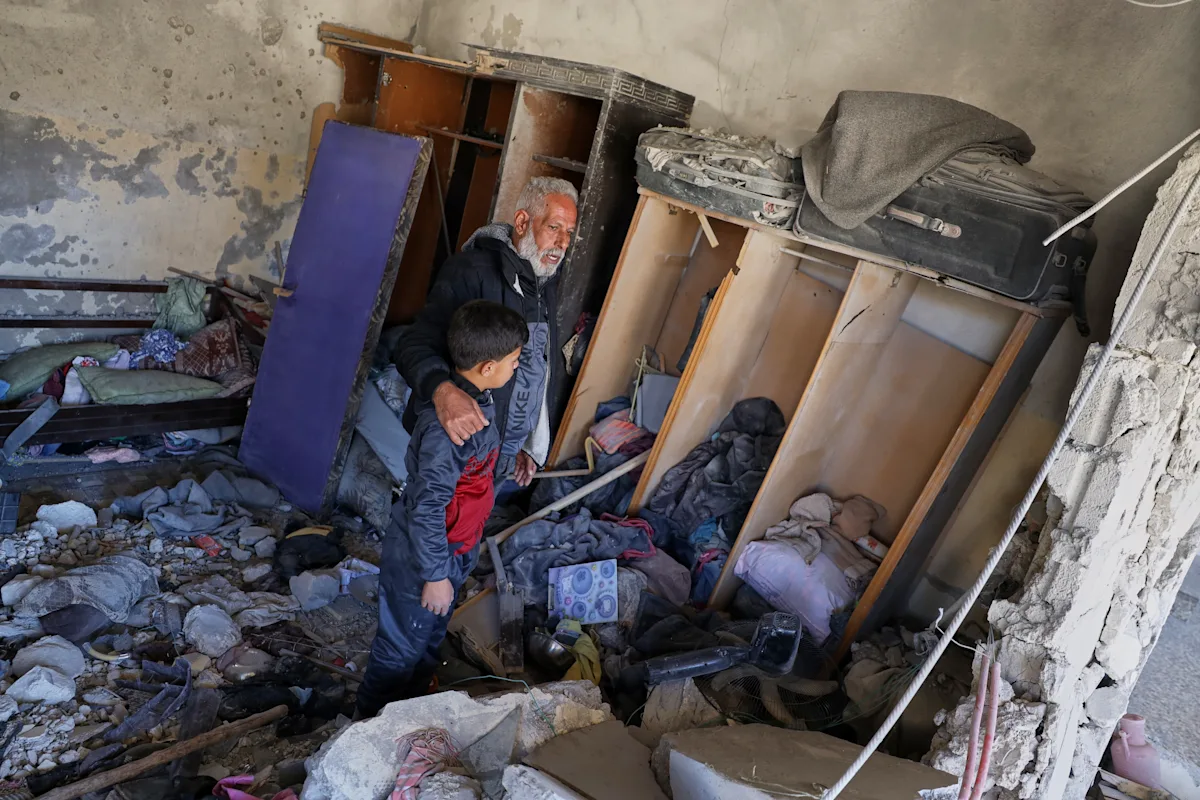
BEIRUT (AP) — Qasim Hamad was awakened by gunfire and explosions in his village in Beitkin, southwest Syria, last month. Within hours, he lost two sons, a daughter-in-law, and grandchildren aged 4 and 10. The five were among 13 villagers killed by Israeli forces that day.
Israeli forces attacked the village – not for the first time – as they said they were trying to capture members of a militant group planning to attack Israel. Israel said militants opened fire on troops, wounding six people, and troops returned fire and provided air support.
Hamad, like others in Beitkin, dismissed Israeli claims that militants were operating in the village. Residents said armed villagers faced off against Israeli soldiers they saw as intruders, and were fired upon by Israeli tanks and artillery, followed by drone attacks. The Damascus government called it a “massacre.”
The attack and similar recent Israeli actions inside Syria have heightened tensions, frustrated locals and dashed any chance of an imminent thaw in relations between the two neighbors despite U.S. pressure.
Israel’s power continues to expand
Reconciliation between Israel and Syria seemed possible after Sunni Islamist-led rebels overthrew Syrian autocratic President Bashar al-Assad, a close ally of Israel’s arch-nemesis Iran, in December.
Syria’s interim president, Ahmed al-Shara, who has led Syrian rebels who have seized the country, has said he has no intention of conflict with Israel. But Israel is suspicious of Shala and distrusts him because of his radical past and his group’s history of allying with Al Qaeda.
The Israeli military moved quickly to impose a new reality on the ground. They mobilized into the U.N.-mandated buffer zone near the Golan Heights in southern Syria, which Israel seized from Syria during the 1967 Mideast war and later annexed — a move that was not approved by most of the international community.
The Israeli army has set up checkpoints and military installations, including on hilltops overlooking large swaths of Syria. They established a landing site on nearby strategic Mount Hermon. Israeli reconnaissance drones frequently fly over towns around Syria, and residents often see Israeli tanks and Humvees patrolling the areas.
Israel says its presence is temporary and aimed at clearing out remnants of pro-Assad forces and militants to protect Israel from attacks. But it gave no indication that its troops would leave soon. Negotiations between the two countries to reach a security agreement have so far not yielded results.
The Ghosts of Lebanon and Gaza
Events in neighboring Lebanon, which borders Israel and Syria, and the two-year war in Gaza between Israel and the Palestinian militant group Hamas have also raised concerns among Syrians about Israeli plans to permanently seize land in southern Syria.
Israeli troops remain in southern Lebanon more than a year since a U.S.-brokered ceasefire ended the latest Israel-Hezbollah war. The war began a day after Hamas attacked southern Israel on October 7, 2023, with Hezbollah firing rockets into Israel in solidarity with its ally Hamas.
Israel’s actions in Lebanon, including bombings of the small country and a ground invasion last year, have severely weakened Hezbollah.
Today, Israel still controls five mountaintops in southern Lebanon, conducts near-daily airstrikes against Hezbollah targets, uses surveillance drones over the country and sometimes conducts nighttime ground incursions.
In Gaza, a 20-point ceasefire signed by US President Donald Trump brought a ceasefire between Israel and Hamas, with plans to create a similar buffer zone under Israeli control even after Israel eventually withdraws its troops from more than half of the territory it still controls.
Speaking at a meeting of regional leaders and international figures in Doha, Qatar, earlier this month, Sala accused Israel of using imagined threats to justify aggression.
“All countries support Israel’s withdrawal from Syria to the front lines before Assad’s ouster,” he said, adding that this was the only way for Syria and Israel to “enter security.”
Syria’s myriad problems
The new leadership in Damascus has faced many challenges since the overthrow of Assad.
Sala’s government has been unable to reach an agreement with local Kurdish-led authorities in northeastern Syria, and after sectarian clashes with local Bedouin tribes in mid-July, large swaths of southern Suweida province are now effectively under administration led by the Druze religious minority.
Syrian government forces intervened, effectively siding with the Bedouins. Hundreds of civilians, mostly Druze, were killed, many by government militants. More than half of the world’s approximately 1 million Druze live in Syria. Most other Druze live in Lebanon and Israel, including the Golan Heights.
Israel, which bills itself as a defender of the Druze, has also made overtures to Syria’s Kurds, although many inside the country are critical of its intentions.
“The Israelis are pursuing a very dangerous strategy,” said Michael Young, senior editor at the Malcolm H. Kerr Carnegie Middle East Center in Beirut.
He added that this contradicted the positions of Saudi Arabia, Turkey, Egypt and even the United States, which “all agree that a unified and reasonably strong Syrian state must be created today”.
Israel and U.S. at odds over Syria
Prime Minister Benjamin Netanyahu said in a video released by his office after inspecting injured Israeli soldiers in Beit Jin, just 5 kilometers (3 miles) from the edge of the U.N. buffer zone, that Israel seeks a demilitarized buffer zone “from Damascus to the (U.N.) buffer zone,” which includes Mount Hermon.
“It is also possible to reach an agreement with Syria, but we will stick to our principles no matter what,” Netanyahu said.
His strategy has proven largely unpopular with the international community, including Washington, which supports Salalah’s efforts to consolidate his control over Syria.
Israel’s actions in southern Syria have drawn rare public criticism from Trump, who has taken al-Sharaa, once on Washington’s terrorist list, under his wing.
“It is very important that Israel maintains a strong and genuine dialogue with Syria and that nothing interferes with Syria’s development into a prosperous country,” Trump said in an article published on the Truth Society after the Beitkin clashes.
Syria is also expected to be on Netanyahu’s agenda when he visits the United States later this month to meet with Trump.
Experts doubt Israel will withdraw its troops from Syria soon, and the new government in Damascus has little influence or power over Israel’s much more powerful military.
“If you set up a landing site, you’re not here for a short period of time,” Issam al-Reiss, a military adviser to the Syrian research group ETANA, said of the Israeli operation.
Hamad, a worker from Beitkin, said he “can no longer bear this situation” after losing five family members.
Israel, he said, “attacks wherever it wants, destroys whatever it wants, kills whoever it wants, and no one is holding it accountable.”
___
Associated Press writer Omar Albam in Beitkin, Syria, contributed to this report.